
Maintaining Natural Gas Pipes - Residential - Illinois Gas - Liberty
Wondering what gas piping is your responsibility?
Click the image below to see.
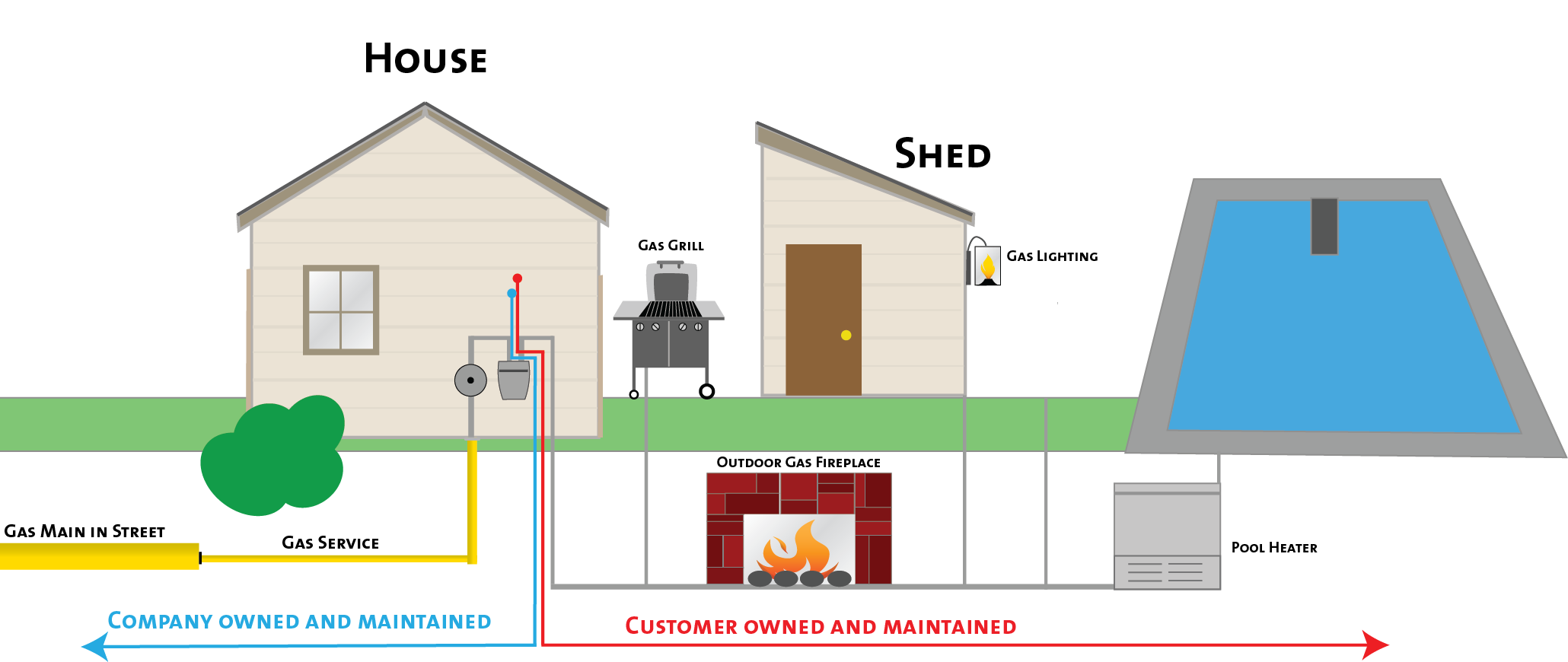
We diligently maintain company-owned pipelines to ensure safety and efficiency. It is important to remember, however, that as a customer, you or the property owner are responsible for customer-owned gas lines that begin at the outlet of the gas meter and extend — either above and/or below ground — to natural gas-burning appliances. Of such customer-owned gas lines, buried gas lines are notable because if they are not properly maintained, the lines may be subject to the potential hazards of corrosion and leaking. While most people do not own buried gas lines, the following are some examples where customer-owned buried piping may be involved:
- Outside gas lighting
- Gas heaters for pool/hot tub
- Natural gas grills
- Detached buildings with gas appliances, among others
To help mitigate these potential hazards, customer-owned natural gas lines should be periodically inspected for leaks, corrosion (if piping is metallic), and any unsafe conditions should be repaired. When excavating near buried pipelines, the piping should be located in advance and excavation done by hand.
To have your gas lines checked, contact your local plumbing/heating contractor or a leak survey and corrosion expert. A fee is involved.
Certain older gas connectors may be dangerous
According to the U.S. Consumer Product Safety Commission, gas connectors are corrugated metal tubes used to connect gas appliances in your home to fuel gas supply pipes. Some older brass connectors have come apart, causing fires and explosions resulting in deaths and injuries. These older brass connectors have a serious flaw in how their tubing was joined to their end pieces. Over time, the end pieces can separate from the tubing, and cause a serious gas leak, explosion, or fire.
The U.S. Consumer Product Safety Commission notes that to their knowledge, these dangerous uncoated brass connectors have not been made for more than 20 years, but many of them are still in use. The older these connectors get, the greater the possibility of failure.
Although not all uncoated connectors have this flaw, it is very difficult to tell which ones do. Therefore, any uncoated brass connector should be replaced immediately with either a new plastic-coated brass or a new stainless steel connector. Connectors should always be replaced whenever the appliance is replaced or moved from its location.
Moving the appliance, even slightly, whether to clean behind it or to inspect its gas connector, can cause the complete failure of one of these older weakened connectors, possibly resulting in a deadly fire or explosion.
Do not move your appliance to check the connector!
WARNING: Only a qualified professional should check your connector and replace it if needed. Do not try to do this yourself.
Corrugated Stainless Steel Tubing (CSST)
Corrugated stainless steel tubing (CSST) is a thin-walled metallic gas piping product that can be used as an alternative to conventional gas piping material. This flexible piping is commonly coated in yellow plastic. If your home uses CSST, we recommend that it is inspected on an annual or semi-annual basis by a qualified plumber for proper installation and bonding.
Homeowners should also perform a visual inspection at least every three months to check for damage. CSST that is not properly bonded could cause an accidental leak or fire when struck by lightning.
Never hang anything on gas piping
You should never hang clothing (or anything else) from gas pipes, because the added weight of clothing (especially wet clothing being hung to air dry) can weaken or break joints or fittings, resulting in a gas leak.